Monday, July 15, 2013

Facebook Comments Lead Pasco Deputies to Robbery Suspect

THE ASSOCIATED PRESS

Published: Sunday, July 14, 2013 at 9:44 a.m.
Last Modified: Sunday, July 14, 2013 at 9:44 a.m.

LAND O' LAKES | Authorities say a suspect wanted for robbery in Pasco County was apprehended after he posted Facebook comments under his wanted photo.

Pasco County Sheriff's Office posted a photo of 23-year-old Matthew Oliver on their Facebook page Wednesday as part of their Fugitive of the Day program.

A short time later, deputies said Oliver posted comments under the photo. Officials did not elaborate on what Oliver wrote.

Bay News 9 (http://www.ittybittyurl.com/Uqj ) reports Oliver was arrested without resistance Friday as he walked outside of an apartment complex wearing a camouflage jacket with the hood up.

Facebook Comments Lead Pasco Deputies to Robbery SuspectTHE ASSOCIATED PRESSTheLedger.comJuly 14, 2013 9:44 AM

<p>LAND O' LAKES | Authorities say a suspect wanted for robbery in Pasco County was apprehended after he posted Facebook comments under his wanted photo.</p><p>Pasco County Sheriff's Office posted a photo of 23-year-old Matthew Oliver on their Facebook page Wednesday as part of their Fugitive of the Day program.</p><p>A short time later, deputies said Oliver posted comments under the photo. Officials did not elaborate on what Oliver wrote.</p><p>Bay News 9 (http://www.ittybittyurl.com/Uqj ) reports Oliver was arrested without resistance Friday as he walked outside of an apartment complex wearing a camouflage jacket with the hood up.</p>

Copyright 2013 TheLedger.com - All rights reserved. Restricted use only.

Source: http://www.theledger.com/article/20130714/news/130719612

Preakness results justin bieber John Hurt taylor swift taylor swift Candice Glover Warriors

Friday, July 12, 2013

'Buddhist bin Laden' or man of peace? Anti-Muslim monk stirs controversy in Myanmar

Paula Bronstein / Getty Images, file

Wirathu is the leader of a Buddhist extremist movement known as 969. He was once jailed for anti-Muslim violence and believes it is vital that Buddhist people keep their business, relationships and land dealings away from followers of Islam.

By Fiona MacGregor, NBC News contributor

YANGON, Myanmar --?A monk has been dubbed the "Buddhist bin Laden" and the "face of Buddhist terror" after launching a campaign against Muslims.

U Wirathu has been accused of inciting?violence against Myanmar's Muslim minority?with fiery sermons claiming the growth of Islam is putting Buddhism and Burmese culture at risk.

About 200 people have been killed by violence since religious riots erupted in June 2012 and tens of thousands fled after homes owned were burned by mobs.

Wirathu, who says he once compared himself to the al Qaeda leader as "a joke," claims?Islamic beliefs can encourage people to have "bad characters." As a key figure in a movement that encourages people to boycott Muslim businesses, Wirathu espouses a form of radical Buddhism which seems incongruous to those in the West who associate the religion with peace and acceptance.

However, the 46-year-old ?monk insists he does not advocate violence against Muslims, who make up just 5 percent of the country's 60 million people.
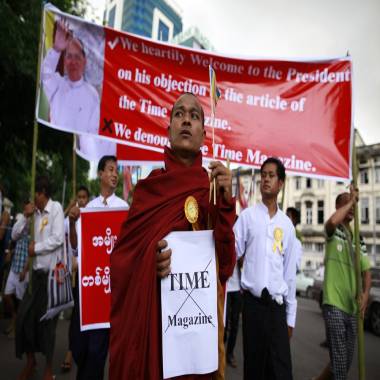
Soe Zeya Tun / Reuters, file

A Buddhist monk and other protesters demonstrate against TIME magazine in Yangon, Myanmar, on June 30.

"I believe Islam is a threat not just for Buddhism, but for the people and the country and the religion," he said.

According to Wirathu, it doesn't matter that Muslims make up a small proportion of Myanmar's population.?

"When someone went into a school in Virginia armed and killed people there, it didn't matter that the teacher and the pupils were the majority," he offers as an illustration.

Last month, TIME magazine's portrayal of Wirathu as "The Face of Buddhist Terror" sparked widespread protests across the country.

But Wirathu laughs at reports that he even branded himself the "Buddhist bin Laden."

"People used to write things like that about me on Facebook, call me that, and the 'bald Bin Laden,' all sorts of names," he said. "I ended up calling myself that as a joke ... and it got reported from there."

In Myanmar, Buddhist religion and culture means monks are generally seen as beyond question because of their holy status, yet at the same time their role has long been political as well as spiritual.

Wirathu's notoriety has grown amid deadly?violence between Buddhists and Muslims in Myanmar, which?is in?its second year on "the road to democracy"?after decades of military rule.

Tensions are highest in the western state of Rakhine, which borders predominantly Muslim Bangladesh. Rakhine has long been the scene of conflict between rival ethnic groups but sectarian violence has increasingly been breaking out in other parts of the country. In May, Buddhist mobs burned Muslim homes in the northern city of Lashio.

Human Rights Watch noted that violence in June and October 2012 "resulted in countless deaths, destruction to property, large scale internal displacement and segregation within Rakhine state of Myanmar."

Other organizations have recorded incidents of mosques and Muslims being attacked in Rakhine state and elsewhere. Tens of thousands of Muslims have been effectively trapped in displacement camps after clashes saw an estimated 200 people killed and?villages destroyed?last year.

Wirathu is behind a pro-Buddhist movement, known as 969. Its badge has been appearing on businesses keen to promote their Buddhist credentials, and encourage other Buddhists to choose theirs over Muslim-run ones. The logo also increasingly appears at rallies and on pamphlets issued by religious and nationalist organizations describing Muslims as a threat.

Wirathu claims he came up with the idea of 969, numbers which represent Buddhist virtues.

He insists it is vital that Buddhist people keep their business, relationships and land dealings away from Muslims because he fears "their population will get bigger than ours" and "shariah law will take over."

Wirathu and others operating under the 969 umbrella highlight videos and images of butchered monks, violent crowds of people in Muslim dress and destroyed temples which they allege show attacks by Islamists targeting Buddhists.

Wirathu insisted he "does not believe that violence will solve the problems" and suggested many of the more inflammatory quotes attributed to him have either been taken out of context or are simply wrong.

"I don't believe that violence is the way forward and I do not want to see Buddhist people ganging up and taking revenge on Muslims," Wirathu said.?

To most Buddhists in Myanmar, the idea that a monk could be responsible for inciting violence is almost incomprehensible, yet many seem happy enough to accept his message of intolerance.

"The monk Wirathu is peaceful person and he is not a terrorist. Look around the world, at Afghanistan, Indonesia, who are the main culprits when it comes to terrorism?" asked Htway Maung Kyaw, an elderly Yangon bookseller, who having studied in the U.K. in his youth is proud to describe himself as "Philologist (London)"

Niels Huby

The Venerable Ashinkumara believes Muslims are plotting to take over Myanmar.

"It is true he was in prison," he said of Wirathu's detention in 2003 under the junta, reportedly for incitiing violence against Muslims. "However, that was under the military regime [when many people were imprisoned]. He was struggling on behalf of humanity."

The Venerable Ashinkumara, a fellow monk and member of the 969 movement, said his controversial friend has "a tender heart."

Ashinkumara, who believes that Muslims are plotting to take over Burma and "are the ones who started all the fights," added: "I don't believe Wirathu has called for violence."

This view that Wirathu is somehow "misunderstood" is expressed by businessman and Buddhist charity founder Ko Moe whose maternal grandfather was Muslim and whose grandmother was he says "forced" to convert from Buddhism.

"Wirathu never told people to fight against Islam," Moe said. "He is trying to give the message that people should protect their own religion and race.

"Not to fight, but there is a big concern that the Muslim population is growing faster than the Burmese people, because they can have many wives and are told not to use birth control," he says, echoing a view heard over and over again in Burma's tea-houses.

Moe points to Indonesia, Malaysia and southern Thailand, which are now predominantly Muslim, as examples of what many in Myanmar fear is their country's future.

Many also express the feeling that they are a minority in their region: a nation of 60 million, dwarved by neighbors India at 1.2 billion and China at 1.3 billion, and conscious of the growing influence of Islam in other Asian nations.

Moe's Piti (Light of Truth) charity helps orphans and people living with HIV, but he has clear religious aims and the organization also works to promote "a proper understanding of Buddhism".

"What Wirathu talks about is patriotism," he said. "It is about protecting our nationality, our race and our religion."

For Muslims born in Myanmar, that is a hard view of patriotism to swallow.?

At a central mosque in Yangon, it's not something people like to discuss publicly, but they feel the discrimination against them is about more than religion.

"I don't believe this is really about religion," one imam said. "It is about certain people trying to gain political power. We Muslims have been here for 1,000 years and are Burmese too."

Related:

?

?

?

?

?

?

?

?

Source: http://feeds.nbcnews.com/c/35002/f/663309/s/2e813623/l/0Lworldnews0Bnbcnews0N0C0Inews0C20A130C0A70C110C193951520Ebuddhist0Ebin0Eladen0Eor0Eman0Eof0Epeace0Eanti0Emuslim0Emonk0Estirs0Econtroversy0Ein0Emyanmar0Dlite/story01.htm

sasha baron cohen oscars the artist sacha baron cohen oscars the old curiosity shop jane russell meryl streep martin scorsese

Fed wants more jobs before slowing bond buys

Economy

4 hours ago

U.S.Federal Reserve Chairman Ben Bernanke speaks to the press following the Fed's two-day policy meeting at the Federal Reserve in Washington in June....

JASON REED / Reuters

U.S.Federal Reserve Chairman Ben Bernanke speaks to the press following the Fed's two-day policy meeting at the Federal Reserve in Washington in June. Meeting minutes indicate that the Fed wants more jobs created before reining in bond buying.

The Federal Reserve wants the job market to improve before it slows the stimulus program that helped speed up the recovery, minutes of the central bank's most recent meeting showed Wednesday.

Even as Fed officials agreed in June about the need to pull back on those economic stimulus measures soon, many wanted reassurance that the employment recovery was on solid ground before a policy retreat.

Financial markets have been wagering on September as the probable start of a reduction in the pace of the U.S. central bank's $85 billion in monthly bond purchases, but minutes of the Fed's June meeting suggested that might not be a sure bet. The bond purchases are aimed at keeping interest rates at historic lows.

"Several members judged that a reduction in asset purchases would likely soon be warranted," the minutes said. But they added that "many members indicated that further improvement in the outlook for the labor market would be required before it would be appropriate to slow the pace of asset purchases."

Global investors have recently recovered from a mild bout of panic that followed Fed Chairman Ben Bernanke's roadmap for an end to so-called quantitative easing, which he said would likely draw to a close by the middle of next year. Financial market fears have been allayed in part by a chorus of Fed officials who have sought to reassure traders that the end of asset buys will not lead to imminent interest rate hikes.

"Many members indicated that decisions about the pace and composition of asset purchases were distinct from decisions about the appropriate level of the federal funds rate," the minutes said.

Whether the markets have gotten the message is not fully clear; the yield on the 10-year U.S. Treasury note has risen a full percentage point in just two months and stands close to its highest levels since 2011.

This has already slowed activity in the mortgage market, which had been key to the recent economic rebound.

At their June meeting, some Fed officials worried not only about the outlook for employment, but the pace of economic growth as well. Many economists believe the economy grew at less than a 1 percent annual rate in the second quarter, although most look for a pick-up in the second half of the year.

"Some (officials) added that they would ... need to see more evidence that the projected acceleration in economic activity would occur, before reducing the pace of asset purchases," the minutes said.

Of the Fed policymakers who argued it would be wise to curtail bond purchases soon, two thought it should be done "to prevent the potential negative consequences of the program from exceeding its anticipated benefits."

Copyright 2013 Thomson Reuters.

Source: http://feeds.nbcnews.com/c/35002/f/663286/s/2e7bc6a1/l/0L0Snbcnews0N0Cbusiness0Cfed0Ewants0Emore0Ejobs0Eslowing0Ebond0Ebuys0E6C10A593764/story01.htm

Michelle Knight Harris Teeter NCAA Football 14 Steam Summer Sale 2013 Randy Travis in critical condition Anna Benson stacy keibler

Thursday, July 11, 2013

(VIDEO) New York Jets Coach Rex Ryan Participates In Spain?s Running With The Bulls

Get the top 10 Yardbarker stories delivered to your inbox Monday-Friday. You can also personalize your newsletter to receive even more stories about the teams and sports that matter to you most. And the best part? It's free!

* Not a Jets fan? Choose another sport or team

Source: http://network.yardbarker.com/all_sports/article_external/video_new_york_jets_coach_rex_ryan_participates_in_spains_running_with_the_bulls/14001620

xavier joan crawford joan crawford john goodman kendall marshall whitney houston news sylvia plath

Rates of cardiovascular procedures differ for medicare beneficiaries

Rates of cardiovascular procedures differ for medicare beneficiaries [ Back to EurekAlert! ] Public release date: 10-Jul-2013
[ | E-mail | Share Share ]

Contact: Mark Couch
mark.couch@ucdenver.edu
303-724-5377
University of Colorado Denver

AURORA, Colo. (July 10, 2013) Rates of angiography and percutaneous coronary interventions were significantly lower among Medicare Advantage beneficiaries when compared to those covered by Medicare fee-for-service, according to a study by a University of Colorado School of Medicine physician published in the July 10 issue of JAMA.

The study, which included nearly 6 million Medicare Advantage and Medicare fee-for-service beneficiaries from 12 states, also found that geographic variation in procedure rates was substantial for both payment types.

"Treatment of cardiovascular disease is one of the largest drivers of health care cost in the United States, accounting for $273 billion annually. Cardiovascular procedures are major contributors to this high cost," according to background information in the article. "Little is known about how different financial incentives between Medicare Advantage and Medicare fee-for-service (FFS) reimbursement structures influence use of cardiovascular procedures."

"Under the Medicare FFS reimbursement structure, physicians are paid more for doing more procedures. In contrast, integrated delivery systems that provide care for Medicare Advantage beneficiaries receive a capitated payment, and physicians working in these settings are not paid more for doing more procedures," the authors write.

Daniel D. Matlock, MD, MPH, assistant professor of medicine at the University of Colorado School of Medicine, Aurora, and colleagues conducted a study to compare the overall rates and local area rates of coronary angiography, percutaneous coronary intervention (PCI; procedures such as balloon angioplasty or stent placement used to open narrowed coronary arteries), and coronary artery bypass graft (CABG) surgery between Medicare Advantage and Medicare FFS beneficiaries living in the same communities.

The study, which included 878,339 Medicare Advantage patients and 5,013,650 Medicare FFS patients older than 65 years of age, compared rates of these procedures between 2003-2007 across 32 hospital referral regions (HHRs) in 12 states.

The researchers found that compared with Medicare FFS patients, Medicare Advantage patients had lower age-, sex-, race-, and income-adjusted procedure rates for angiography and PCI but similar rates for CABG surgery. There were no differences between Medicare Advantage and Medicare FFS patients in the rates of urgent angiography. When examining procedure rates across HRRs, there was wide geographic variation among Medicare Advantage patients and Medicare FFS patients.

###

About the University of Colorado School of Medicine

Faculty at the University of Colorado School of Medicine work to advance science and improve care. These faculty members include physicians, educators and scientists at University of Colorado Hospital, Children's Hospital Colorado, Denver Health, National Jewish Health, and the Denver Veterans Affairs Medical Center. The school is located on the Anschutz Medical Campus, one of four campuses in the University of Colorado system. To learn more about the medical school's care, education, research and community engagement, please visit its web site. For additional news and information, please visit the University of Colorado Denver newsroom


[ Back to EurekAlert! ] [ | E-mail | Share Share ]

?


AAAS and EurekAlert! are not responsible for the accuracy of news releases posted to EurekAlert! by contributing institutions or for the use of any information through the EurekAlert! system.


Rates of cardiovascular procedures differ for medicare beneficiaries [ Back to EurekAlert! ] Public release date: 10-Jul-2013
[ | E-mail | Share Share ]

Contact: Mark Couch
mark.couch@ucdenver.edu
303-724-5377
University of Colorado Denver

AURORA, Colo. (July 10, 2013) Rates of angiography and percutaneous coronary interventions were significantly lower among Medicare Advantage beneficiaries when compared to those covered by Medicare fee-for-service, according to a study by a University of Colorado School of Medicine physician published in the July 10 issue of JAMA.

The study, which included nearly 6 million Medicare Advantage and Medicare fee-for-service beneficiaries from 12 states, also found that geographic variation in procedure rates was substantial for both payment types.

"Treatment of cardiovascular disease is one of the largest drivers of health care cost in the United States, accounting for $273 billion annually. Cardiovascular procedures are major contributors to this high cost," according to background information in the article. "Little is known about how different financial incentives between Medicare Advantage and Medicare fee-for-service (FFS) reimbursement structures influence use of cardiovascular procedures."

"Under the Medicare FFS reimbursement structure, physicians are paid more for doing more procedures. In contrast, integrated delivery systems that provide care for Medicare Advantage beneficiaries receive a capitated payment, and physicians working in these settings are not paid more for doing more procedures," the authors write.

Daniel D. Matlock, MD, MPH, assistant professor of medicine at the University of Colorado School of Medicine, Aurora, and colleagues conducted a study to compare the overall rates and local area rates of coronary angiography, percutaneous coronary intervention (PCI; procedures such as balloon angioplasty or stent placement used to open narrowed coronary arteries), and coronary artery bypass graft (CABG) surgery between Medicare Advantage and Medicare FFS beneficiaries living in the same communities.

The study, which included 878,339 Medicare Advantage patients and 5,013,650 Medicare FFS patients older than 65 years of age, compared rates of these procedures between 2003-2007 across 32 hospital referral regions (HHRs) in 12 states.

The researchers found that compared with Medicare FFS patients, Medicare Advantage patients had lower age-, sex-, race-, and income-adjusted procedure rates for angiography and PCI but similar rates for CABG surgery. There were no differences between Medicare Advantage and Medicare FFS patients in the rates of urgent angiography. When examining procedure rates across HRRs, there was wide geographic variation among Medicare Advantage patients and Medicare FFS patients.

###

About the University of Colorado School of Medicine

Faculty at the University of Colorado School of Medicine work to advance science and improve care. These faculty members include physicians, educators and scientists at University of Colorado Hospital, Children's Hospital Colorado, Denver Health, National Jewish Health, and the Denver Veterans Affairs Medical Center. The school is located on the Anschutz Medical Campus, one of four campuses in the University of Colorado system. To learn more about the medical school's care, education, research and community engagement, please visit its web site. For additional news and information, please visit the University of Colorado Denver newsroom


[ Back to EurekAlert! ] [ | E-mail | Share Share ]

?


AAAS and EurekAlert! are not responsible for the accuracy of news releases posted to EurekAlert! by contributing institutions or for the use of any information through the EurekAlert! system.


Source: http://www.eurekalert.org/pub_releases/2013-07/uocd-roc071013.php

St Patrick lisa vanderpump Dancing With the Stars 2013 NIT Bracket March Madness 2013 bracket March Madness 2013 selection sunday

Tuesday, July 2, 2013

Blog Exercises: Self-Sabotage Writing ? Lorelle on WordPress

You probably don?t want to hear this?I?m sure you don?t care what I have to say anyway?if you aren?t interested, go somewhere else?if you are here to learn something stick around, if not, take a hike?I don?t expect you to figure this out?This does require some intelligence to understand, so if you can?t be bothered, close your browser now and save my bandwidth?I?ve nothing important to say?I?m sure you know this already?like I have anything special to say about anything?I?m just a worthless nobody so why should you listen to me?I?m sure I?m wasting your time?

Blog Exercises on Lorelle on WordPress.Have you read these lines? Have you seen them on blogs around the web? I have. I started collecting these self-sabotaging lines a couple months ago after running across a rash of negative self-talk writing.

You would expect that some of these came from highly personal bloggers babbling about their lives, mostly from young people who often seem to thrive on this self-doubt and negative speak. These didn?t come from personal blogs. These came from professional blogs. Most of these came from intelligent people writing on intelligent and thoughtful subjects, some even educational.

Whether conscious or unconscious, it slipped into their writing.

I wish I was kidding. I was reading an excellent technical explanation on a subject I?ve found challenging before, and I was getting it. It was so exciting. It clicked. The writing was solid, the explanation plain and simple, it made sense. I was thrilled, proud of myself, until I got to the last paragraph. It slapped me in the face, sinking my enthusiasm.

?I?m sure this is old news and you?ve had it explained better elsewhere, so I probably wasted your time, but I hope it helped.?

WHAT? Your words were beautiful, like poetry, helping me to understand a challenging subject that you pass off like the complex art of boiling water. You made it easy for me. I got it! Yet you think you didn?t do good enough? I wanted to cry.

Blog Exercise Task from Lorelle on WordPress.Your blog exercise today is to check your self-sabotage writing at the door.

My goal with this exercise to to get you to think about what you write and how you write, and if it is truly reflective of you and your writing. When you stumble across it 10, 20, or even 40 years from now, I want you to find a measure of pride and pleasure in what you wrote.

Consider what you might think about yourself, or others will think about you, when they read your site in the future? If you don?t care, blog on. If you do, then take the appropriate steps to ensure you?ll be happy with your words years from now.

We all have self-doubt. Expressing it through your personal blog can often bring self-confidence as well as overcoming your doubts. Through expression, we often come to a greater realization of the power we have within us to do and be anything. So express yourself and show off your confidence.

In other words, kill all signs of self-sabotage writing.

We are more forgiving with personal blogs. We expect self-deprecation. When it comes to writing technical articles and covering technical topics, I think I speak for all of us by saying we have a measure of expectation when it comes to quality control.

We expect these articles to be:

  1. Spell-checked and edited for clarity
  2. Researched with links to supporting documentation
  3. Specific, to-the-point instructions and guides helping us understand the process
  4. Visually supported with images and video to provide multiple modes for learning

A technical article must be edited to showcase you as the expert, the one who knows it all, the one is who right and eager to present and defend his or her expertise. The last thing a reader wants to see if your self-confidence flagging. They want ? they need ? you to be at your best so they have confidence in you as the instructor.

Sure, it?s funny the first time to hear about how you came up with an idea for a new WordPress Plugin while holding a baby in one arm, washing dishes with the other, directing the traffic of four other children running around in the kitchen, cooking dinner, and talking on the phone all at the same time. None of that information helps us understand how to install the WordPress Plugin, why we should use it, and how to make our lives and sites work better. That kind of personal information can make the technical stuff fun to read but can bog down the real point and purpose of the article.

What isn?t fun to read in technical writing is the author telling me to ?pay attention to what I?m saying here or take your eyes somewhere else and don?t waste my bandwidth.? Yikes! I wish I was making that up.

Negative rants in technical writing is unnecessary and accusatory. I feel like I?ve done something wrong before I?ve even finished reading the piece.

When I find the information I?ve been hunting for, even if I didn?t spot the signs of low self-esteem writing, it still sinks into my unconscious. I start doubting my ability to follow through on the instructions. I mess things up. I start thinking it?s me. What did I do wrong?

How to Write Like You Mean It

When we write, we like to believe that we are writing for ourselves, when in fact, most of the time we are writing either to ourselves or to someone else, consciously or unconsciously. When working on technical manuals like the WordPress Codex and the technical how to tips here on this site, I put myself before two audiences as I go through the process.

I begin by writing to me. I remember what it was like to learn how to do this the first time, and I make a note of all the things I wish I?d been told before I began that would have made the process easier. Writing from first hand experience, I figure if I suffered through this and that, you might, so how can I write this so you won?t suffer.

Then I reread the article with you, the user, in mind. What points are important for you to know before, during, and after to help you make this work. I simplify the language and clean out any personal references to leave behind solid instructions. I visualize you, the user, hunkered over your computer late at night, trying to figure out how to make all these complex looking bits of code do something you think should be easy but it turning into a late night bad comedy hour. The more I think about how you are probably doing this at the last minute before you go to bed because you have a few minutes to spare and you thought you could just whip through this, but you can?t, so here you are, a nagging headache of exhaustion and you give up and turn to the WordPress Codex for help. We?d better be able to help.

The last thing you want to read is how much I think you are wasting your time by reading this.

It?s your turn to do the same. Check your self-sabotage writing at the publish button. Go through your posts and make sure that all the signs of doubt in your abilities when offering expert advice and technique is gone.

Remember to include a hat tip link back to this post to create a trackback, or leave a properly formed link in the comments so participants can check out your blog exercise task.

You can find more Blog Exercises on Lorelle on WordPress. This is a year-long challenge to help you flex your blogging muscles.


Feed on Lorelle on WordPress Subscribe Feedburner iconVia Feedburner Subscribe by Email

Copyright Lorelle VanFossen.

Reach out and touch someone social:

Like this:

Like Loading...

Source: http://lorelle.wordpress.com/2013/07/01/blog-exercises-self-sabotage-writing/

jet crash virginia beach petrino clayton kershaw tyler perry face transplant fab melo google glasses

Why I would rather live in Gaza than Egypt, my birthplace

The hell of Gaza is better that the paradise of Egypt: This could be hard to believe since Gaza has a reputation of being unsafe, but this is the conclusion I have reached after searching for a safer place to live with my wife and baby boy.

How could this be? Just two years ago, Egypt appeared to some to be on the cusp of an exciting democratic revolution, which would bring more power to the people and give them the freedom Arabs across the Middle East have been yearning for after half a century of Western-backed dictators.

Instead, on my nine visits since then, I have found the country so changed for the worse that I would rather live in a tiny coastal territory with no sovereignty, unemployment rates of more than 30 percent, and a government punished by Israel and the West, both of which consider the ruling Hamas movement to be a terrorist organization.

RECOMMENDED: How much do you know about Egypt? Take this quiz.

To be sure, I have faced frequent violence between Israel and Gaza militants, as well as hazards in my career as a journalist ? especially during military conflicts with Israel, such as the 2008-09 war and the 2012 Pillar of Defense operation.

And I thought I had found a way out.

In 2012, I got Egyptian citizenship, since I was born to an Egyptian mother and a Palestinian father. This, together with my desire for safety and stability, was a strong motive for me to move back to Egypt, where I was born and spent 14 years of my childhood, and where three sisters and my mother's family live.

I received more than half a dozen job offers from media outlets, and also had promising plans to start an education center to teach students English, math, science, and other subjects.

The salaries were not as high as what I receive in Gaza, but since I was looking for safety and stability, I did not care much about money. Things were rosy in my eyes, although many of my relatives and friends in Gaza criticized my decision because the economic and security situation in Egypt was not that good.

I did not believe them until last month.

I traveled to Egypt together with a coworker to receive a media course for TV journalists, which also drew journalists from Yemen, Libya, Iran, and China.

On the second of day of the course, we had a field training, in which we were to film a feature story about how the roadblocks placed by the police around government buildings negatively impacted the lives of both pedestrians and residents downtown.

While filming, we were in front of Tahrir Square, the birthplace of the Egyptian revolution. A Yemeni colleague was taking photos with his mobile phone of the place that means a lot for a Yemeni who demonstrated in Sanaa?s Change Square to topple a dictatorship.

As he was taking pictures, a teenager snatched the iPhone 4 from my colleague?s hand and walked away confidently. The Yemeni followed him and tried to stop him. To his surprise, the boy turned back with a knife in his hand and threatened that he will stab my colleague if he continues to ask for the phone.

We were nine guys and three women. We thought that we could help him if we all go out of the minibus and frighten the boy, but the boy went wild and started to scream.

A few seconds later, more than 20 of his peers came with knives and sticks and were about to attack us. An older guy riding a motorbike came and the boy jumped behind the biker and they sped off. No one even tried to stop and watch what was going on. At this very moment, our fear made us get into the minibus and drive away.

This was a turning point for me. After watching this, only one thing was on my mind, how could I live here? It's not the incident itself that made me change my mind to move to Egypt, but rather the passersby who were watching us being attacked and blackmailed by thugs at daytime. While Egyptians are known for being helpful, the spike in criminal activity has made many reluctant to intervene as they would have before the revolution.

Tahrir Square is one of the most crowded squares, if not the most, in Egypt. To have your cellphone stolen at daytime and in front of hundreds of watchers, one needs to think 100 times before deciding to settle in Egypt, but thank God, I only thought once and decided not endanger the lives of family in country that almost has no safety.

It's not that I've given up on Egypt forever. My love of Egypt is endless and priceless. It's my birthplace and the country that embraced me for 14 years, the country that granted me citizenship.

But I feel so sad that Egypt is no longer safe. Once this country was the safest place in the world with millions of foreign tourists spending their most beautiful times under its warm loving sun or enjoying its golden beaches.

The problem is that after the revolution the prisons were emptied. There now seem to be more criminals than policemen on the streets. I have heard true stories of rape, kidnapping, murder, and many crimes.

One more thing that has frightened me about the new Egypt: extremism. Islamic extremism is growing rapidly in Egypt, this has been notable after the revolution, and more clear after the Muslim Brotherhood?s Mohamed Morsi took office a year ago today.

Gaza is ruled by an Islamic party, but there is no extremism. Gaza is blockaded and frequently attacked by Israel, but the crime level is very low and internal security is near to excellent.

From my heart, I hope that Egypt will be safe like Gaza soon.

Ahmed Aldabba is a correspondent for The Christian Science Monitor in Gaza City, Gaza.

RECOMMENDED: How much do you know about Egypt? Take this quiz.

Related stories

Read this story at csmonitor.com

Become a part of the Monitor community

Source: http://news.yahoo.com/why-rather-live-gaza-egypt-birthplace-132900386.html

Jason Kidd weather.com Leyla Ghobadi Dodgers brawl Sebastien De La Cruz farrah abraham national weather service